


Start Now, Not Later

Waiting only makes things harder.
Whether it’s your workout, a side hustle, or that to-do list, procrastination is sneaky.
The trick? Just start, even if it’s a tiny step.
Your brain loves comfort. If something feels hard, your brain hits the Avoid button. You scroll social media, binge-watch a show, and tell yourself you’ll be “more ready” tomorrow. You won’t.
There’s also the motivation myth, the idea that we need to feel inspired before we take action. The opposite is true. Take action first to create motivation.
The Five-Minute Rule. The hardest part is getting started. That initial resistance is huge. Once you commit to just five minutes, you break the inertia. You find that once you start, you want to keep going.
Make It Stupid-Easy. If starting feels like a hassle, remove the friction. Want to exercise? Set out your gym clothes so they’re ready to go. Need to write? Open the document so you don’t have to fumble around. When you reduce the effort required to begin, it’s more likely you follow through.
Set Mini Goals. Big tasks intimidate. Break them into bite-sized pieces to make them manageable. Instead of “I have to clean the whole house,” tell yourself “I’ll tidy just this one drawer.” Instead of “write a report,” make it “Write one paragraph.” Small wins build momentum.
Cut Distractions. Your attention is pulled in different directions. Social media, emails, notifications. Remove distractions to focus. Put your phone in another room, close unnecessary tabs, and set a timer to work in bursts.
Celebrate Small Wins. We only reward ourselves when something is finished. Celebrate small achievements to stay motivated. Check off a task, notice improvement, or hit a milestone. Take a second to acknowledge your progress.
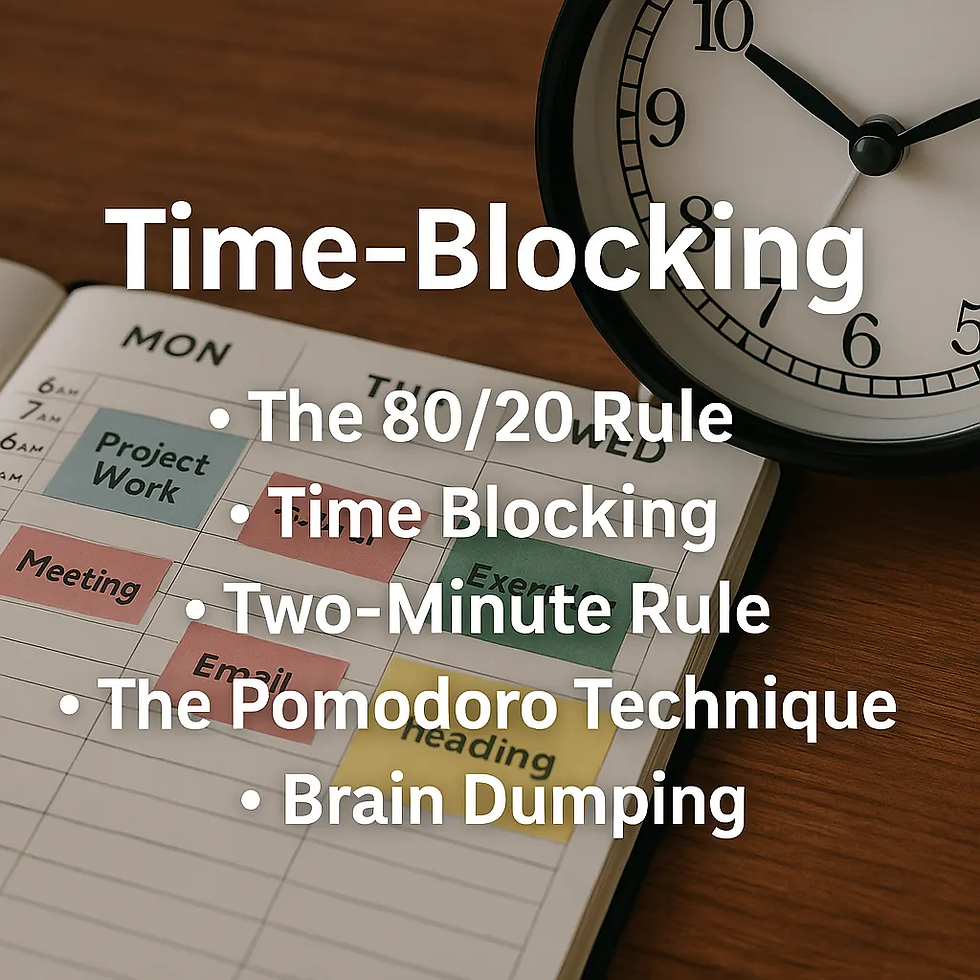
The 80/20 Rule (Pareto Principle). 80% of your results come from 20% of your efforts. Focus on the high-impact tasks that move the needle. Identify where your time and energy create the biggest results.
Time Blocking. Assign time slots to different activities. Instead of “I’ll work on that later,” set aside a defined period. 10 AM to 12 PM for deep work, or 3 PM to 4 PM for answering emails. Set boundaries keep distractions away.
Two-Minute Rule. If a task takes less than two minutes, do it immediately. Small tasks pile up to create unnecessary mental clutter. Tackle them right away to clear up your to-do list fast.
The Pomodoro Technique. Prevent burnout. Alternate work and rest periods. Work in 25-minute chunks (Pomodoros), followed by five-minute breaks. After four rounds, take a longer 15–30 minute break.
Brain Dumping. When overloaded with ideas, worries, or tasks, write everything down to organize your thoughts. Once it’s all out, sort through the list, identify priorities, and turn scattered thoughts into actionable steps.
The Eisenhower Matrix. Sort your tasks based on urgency and importance. Tackle urgent and important tasks now. Important but not urgent tasks need to be scheduled. Urgent but not important tasks can be delegated. Neither urgent nor important tasks can be eliminated. Don’t waste time on things that don’t matter.
Single-Tasking. Constant task-switching reduces efficiency and leads to mistakes. Give your full attention to one thing at a time.
Batch Similar Tasks. Group similar tasks together. Answer all emails together rather than responding sporadically. Do all your content planning in one block. This minimizes mental shifts, saves time, and smooths your workflow.
Use the “Done List”. Keep track of what you’ve completed. Recognize progress. A list of finished tasks reminds you how much you’ve accomplished to keep you motivated.
Limit Decision Fatigue. The more decisions you have to make, the harder it is to make good choices. Simplify everyday decisions. Plan meals for the week, wear a go-to outfit, and automate routine tasks. This conserves mental energy for important decisions.
The longer you wait, the harder it feels. The secret? Start before you feel ready. Even the tiniest step counts.


Comments